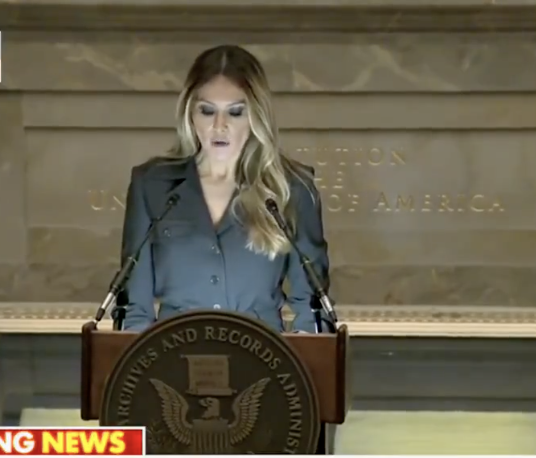
Ukraine’s human rights commissioner, Dmytro Lubinets, said Friday evening that every resident of Russian-occupied Oleshky who asked to go to Ukrainian-held territory had left the city under the local ceasefire First Lady Melania Trump arranged. “All residents of Oleshky who wished to leave for territory controlled by Ukraine were able to do so,” Lubinets said, according to UA.News.
Russia’s human rights commissioner, Yana Lantratova, announced the same evening that the humanitarian mission was complete and that “those who decided to leave for Ukraine have been given that opportunity,” Interfax-Ukraine reported, citing Russian media. By Saturday morning, planes carrying evacuees had landed in Gomel, Belarus, where they were to board buses for the border crossing into Ukraine, UkrMedia reported.
Self Reliance Central reported Friday that a Ukrainian delegation had reached the city but that no evacuee count had been released. Kyiv has still not released a final count.
How the evacuation worked
Lubinets said Oct. 29 that 25 buses with about 750 seats, plus ambulances, had been prepared and that demining of the designated routes was finished, the Kyiv Independent reported. UA.News reported that 17 buses headed toward Ukraine and that the number bound for Russia was “several times smaller.”
The route to Ukraine ran through Russian-held ground. Buses crossed occupied Crimea to Anapa in Russia, Russian military transport planes flew the evacuees to Gomel, and buses were to take them to the Nova Huta crossing, UkrMedia reported. Its headline counted four planes; Belarus’s state news agency BelTA reported three. Lubinets said there was no other safe route and that residents who had not registered in advance were also allowed to leave.
Prime Minister Serhii Koretskyi said Oct. 30 that 527 residents planned to go to Ukrainian-held territory, then said he had given the figure “by mistake.”
Aid delivered, no violations reported
“Humanitarian aid has been delivered,” Lubinets said, according to Interfax-Ukraine. UkrMedia reported that food, drinking water, medicine and other essentials went to residents who chose to stay. No tonnage has been published. The White House had estimated that 1,700 to 2,000 people, mostly elderly and including about 50 children, remained in the city.
“The ceasefire has been in effect for 87 hours. No violations have been recorded,” Lubinets said Friday. He said the work followed agreements with Lantratova “with the assistance and coordination of U.S. First Lady Melania Trump.” The agreed pause runs until 10:59 p.m. local time on Nov. 1, UkrMedia reported.
A Ukrainian volunteer, Kseniia Arkhipova, said Russia broke the terms by starting to move people on Oct. 29, a day early, the Kyiv Independent reported. Kherson Gov. Oleksandr Prokudin said one person was hurt by a Russian mine that day. Russia has not responded to either claim.
The bottom line
The White House announced the Oleshky agreement on Oct. 23. A week later, the human rights commissioners of Ukraine and Russia described the result in nearly the same words: the people who wanted to leave for Ukraine left, aid reached those who stayed, the routes were cleared of mines, and Ukraine’s commissioner reported no violations after more than three and a half days.
The First Lady set a narrow goal: get elderly residents out of a front-line city and food to the people who stayed. Both governments now say that happened. The result can be checked against the numbers each side publishes.
The work is not complete until the evacuees are home and counted. Kyiv should publish how many people crossed at Nova Huta, and Moscow should say how many went into Russia. If those numbers hold up, the same model should be tried in the next besieged town